
How We Think
Growth is systemic.
It should be managed that way.
Most organizations are built around functions. Growth isn't.
Results emerge from how strategy, people, processes, technology, and decisions work together across the business. Coherist looks at the whole system to understand what's driving performance—and where friction is getting in the way.
The Problem
Good decisions can still create a bad system.
Most organizational friction isn't created by obviously bad decisions. It develops when reasonable decisions are made within one part of the business without seeing how they affect the rest.
Teams optimize for different outcomes.
Each function can hit its own goals while the business still misses the larger objective.
Solutions create new complexity.
A new tool, process, hire, or initiative may solve one problem while creating friction somewhere else.
Handoffs become failure points.
What works inside one team can break down when information, responsibility, or work crosses functional boundaries.
Activity competes with priorities.
Organizations keep adding initiatives without removing work, making it harder to distinguish what matters from what is merely urgent.
Our Framework
The Whole Game Doctrine™
The Whole Game Doctrine™ is the framework behind how Coherist approaches growth, strategy, and organizational performance.
Instead of starting with a department, tactic, or predetermined solution, we start with the business outcome and work backward through the system producing it.
That means understanding how strategy, people, processes, technology, and execution interact—and where a problem that appears in one part of the business may actually originate somewhere else.
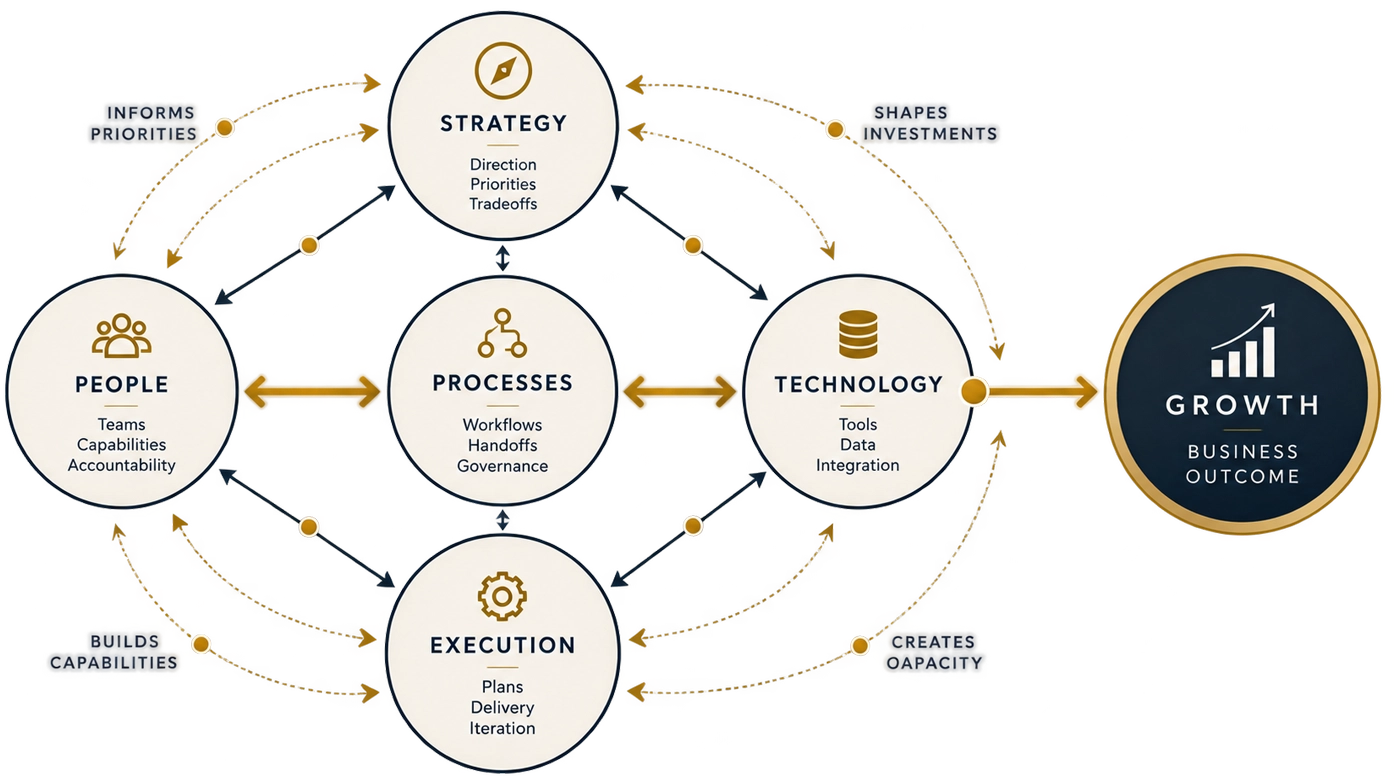
A Whole-System View
What changes when you see the whole game.
Looking at the whole system changes the questions you ask. Instead of asking which function is underperforming, you can examine how decisions, dependencies, and competing priorities are shaping the outcome.
What you see differently
Problems that cross functional boundaries
Dependencies hidden by organizational structure
Local decisions creating downstream friction
Activity that isn't advancing the larger objective
Symptoms that originate somewhere else
What it changes
Where leadership focuses attention
Which problems get solved first
What should be simplified or stopped
Where greater alignment is needed
Which decisions can create the most leverage
The Coherence Lens
Three dimensions. One connected system.
Coherist examines organizational coherence through three complementary dimensions. Each reveals a different place where otherwise sound strategies can lose effectiveness.

What are you trying to accomplish, understand, or change?
Let's start the conversation.
No commitment. Just a discussion.